Dandelion Citrus Jelly

I was gonna make dandelion marmalade, but opted for a fresh challenge of making a jelly minus any commercial pectin. The process I used followed - more or less - the process for making this Cramaillotte.

It all started with Mr. Spouse harvesting a small bucket of dandelion blooms. Many hands - even just four - make light work!
I sat on the deck, under the umbrella, in meditation, separating the "petals" (florets) from the sepals, doing my best to get as little green as possible.

This, in case you're wondering, is the same beginning step for making dandelion mead or wine (which we see in our future).
We ended up with about a quart of gently packed dandelion "petals."
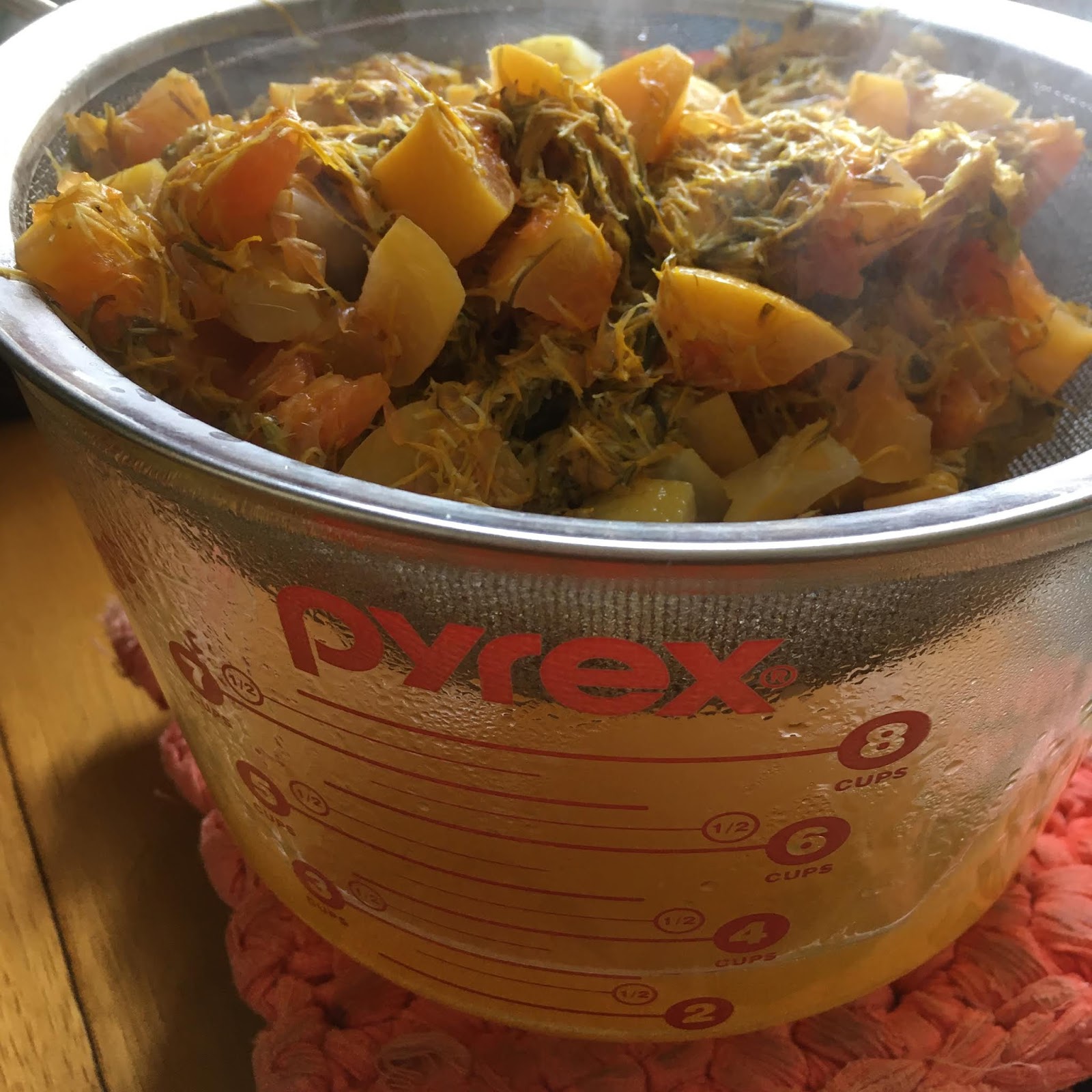
I chopped up a very ripe organic grapefruit and a half a lemon to add to the pot, because that's what I had, and then added water to cover, which was about a quart.
It all simmered together, covered, for about an hour.
I strained and squeezed as much juice as possible from the simmered brew, ending up with about 3 cups of liquid. So I returned the strained juice to the pan with 3 cups of sugar (equal parts by volume), and ended up simmering it another 50 minutes 'til it reached a thick thread stage.
Then it all got ladled into sterilized, hot jelly jars, and capped with hot lids. I used the ::gasp:: European method of flipping the hot jars until they cooled and sealed, a process frowned upon my our USDA (which advocates the wasteful hot water bath, even for wee batches like this. Americans love waste.).

So we ended up 3+ cups of jelly, to make these four jars, plus another not quite full for the frig.

It's quite lovely, a bit of spring sunshine in a jar  and I owe my success to the spirit of my mother-in-law who I invited to join me in the kitchen, because she was the jelly-maker of jelly-makers. ::nods::

Peace. πŸ•Š

Mid April Vernal Blessings

It was a sweet day. I was able to make eye contact with several folks, one to two at at a time, for short snippets, at extra safe distance. And I am grateful. 

At home, time in the gardens and greenhouse nourished me in ways that really can’t be expressed with mere words. A walk through the gardens and wild spaces (which overlap) delighted me with...
...echinacea...

 ...chickweed...

 ...valerian...

...Saint Joan’s wort...

...lungwort...

...perpetual spinach...

 ...comfrey...

...nigella...

...horehound...

...and nettle. Beloved, one and all.

And I count my blessings. And do my best to share them with others. 

Peace. πŸ•Š

Vernal Emergings

We - meaning Mr. Spouse Boy, along with the dog, the chickens, and wildlife with whom we're blessed to share space - are making time, as we do every turn of the wheel, to wander and awaken with wonder. And this spring's awakenings are especially welcomed, despite the lackluster winter, and because of our shared COVID-19 challenges. Not to mention personal challenges that we all have to work through. Right? And so, because of and despite of, we gather the Medicine of the rooted life emerging around us...
 Yarrow: Even deep wounds can heal.

 Vinca and Schizandra: The heart must reach as it chooses.

 Trillium: Sacred patience for the long haul.

 Heal All: Make Medicine in the world.

 Tusilago: Fuck the fear and breathe easy.

 Butterbur: What Tusilago said.

 Saint Joan's wort: Chill.

Wild salad pickin's: EnJOY what you've got. Share what you can.

Peace. πŸ•Š

Good Medicine

 Amid my own personal challenges...
 Amid the challenges of the world we all share right now...
 I am grateful for the emerging season of spring...
 The eternal promise that it holds...
The beauty it expresses... 
And the Good Medicine that it offers.

Peace. πŸ•Š

A Tea "For Every Goddess"

I was called to mix up a little "For Every Goddess" tea blend this week ~ for a friend and for myself. A perfect blend for this full moon, methinks. And, quite frankly, anytime.

This blend came to me around 1999, though in a much simpler form. It has evolved over the years to the blend pictured here that includes red raspberry leaf, hibiscus, red clover blossom, linden flower ‘n’ leaf, rose petals, lemon verbena, peppermint, ginger root, marshmallow leaf, goldenrod leaf, Bermuda grass, and much love.


I challenge tea goddesses everywhere to play with this blend, to take it, add to it, take away from it, and make it yours... for the full moons, the new moons, and all the moons between. 


Peace. πŸ•Š

Botanical Medicine Sticks

I've been making botanical Medicine sticks this week. Every year I make several for me, but this year I'm inspired to roll, and roll, and roll. I use them for smoke/smudge sticks with varied purposes, but mostly to invite energies into whatever space I'm creating. I also use them as altar pieces, to tuck into drawers and storage bins to protect the contents from moths and other vermin, and as healing wands. Or just to tuck here 'n' there because they smell so delicious. They have lots of Medicine share. 

These sticks pictured here are created with Thuja occidentalis (white cedar), Artemisia ludoviciana (prairie or sacred sage, and more), and Artemisia vulgaris (cronewort or mugwort), with one half including Achillea millefolium (yarrow), and the other half with two Monarda species (bee balm), all from our own little acre.

Since the ol' Thuja, or white cedar, if you prefer, needs a trim, I'll be making more, with 17 set as gifts for a special clan of healers that gather twice a year in my corner of the world. 


I may be inspired to make more, as the process is peaceful Medicine, and sacred creation. I'll wait for guidance from the plants. And if I do, and if they include A. vulgaris, they'll be made with mugwort from my friend Sherrie’s sacred patch. 


Yeah. I may be inspired. ::nods:: 


Peace. πŸ•Š


Drying the Monarda Species

Beautiful Monarda, beloved bee balm.

It has hung to dry, and now it’s time to strip the leaves and flowers from the stems. Then it finds its way to be wrapped in a large cotton cloth, and then into the freezer it goes for two days. Once it returns to the air we share, it'll be finished in the dehydrator, just to be sure there's no lingering moisture, and lovingly placed in paper bags for bulk storing.

This is the only plant with which I’ve ever had a challenge with vermin. So the extra step of freezing the dried plant matter for 48 hours or so ensures that any little critters or their eggs are killed - with a blessing - and that I end up with a quality, bug-free stash of bee balm to see me through winter.

It is extra effort of grand worthiness. Even if I don’t deserve it, this plant most certainly does. ::nods::


Peace. πŸ•Š

Floral Medicine


Every day now there's something to be harvested. This morning I'll survey our little acre to see what will have my attention for harvest when I return from my creative time at the studio.

Already I know there will be more comfrey leaves to harvest for drying, and red clover blossoms. Yarrow buds, blossoms 'n' leaves will call to me, and most certainly more bee balm. The calendula is just starting to bloom, so more blossoms will be added to the infused oil jar. And Mr. Spouse Boy will likely harvest more Saint Joan's wort, though we're close to our fill for the year.

Plus I'll be looking for and harvesting other buds, blooms and blossoms, as floral Medicine has been calling to me this year. I have a collection of June blossoms, and am now working on collecting July floral Medicine. I'm not sure (though I have a guess or two) how this Medicine will evolve 'n' make manifest, but I'm confident that the call is worthy, and that the voices of the botanicals will sing their song to me ~ when the chorus is ready.

Of all the lessons that the plants have taught me, one key is that we can't rule or force them in any way. Not for their growth, bounty, beauty, their utility, Medicine, stories... their gifts, whispers, songs... their mystery...

I follow their lead, as they are more wise than I - or any two-legged - shall ever be.


Peace. πŸ•Š

Every Day There is Something

Every day there is something in life to harvest. 
Every day there is something in life to plant. 
Every day there is something in life to receive. 
Every day there is something in life to give.

~ A lesson from the plant realm.


Peace. πŸ•Š

The Drying Room

I adore the scent of this room when my botanical friends are making their journey to be with me throughout the year.

This is just one section of the first line hanging to dry.

The drying room is north facing, so it never gets direct sunlight, even when the shade is up, which is rare through the spring-to-summer-to-autumn months. 

Now I wait for the morning to dry up so that I may harvest and prepare more for the drying room. Soon it will be akin to a jungle, or so I conjure. :)

In the meantime, I count my blessings.

Peace. πŸ•Š

Our Keepers


Wild flowers are powerful and vital Medicine. 

For us, sure, but more so for our keepers, the pollinators, and Nona Gaia herself. 

It's a damning shame that most of us mow them down before they're ever able to offer their full expression. 

Of what are we afraid?
Who's lead are we following?
Is scarcity our altar?

Askin' for a friend.


Peace. πŸ•Š

Solidago in Winter

It's a cold, cold day in January. I have seed packets to organize into a calendar of action, and some to get started, but I thought I'd catch up on vinegar (and other) infusions that got pushed to the back of the priorities shelf. What you see here is the plant matter marc of our local Solidago sp. (goldenrod) left from an infusion made on a sunny August day. Beautiful, isn't it?
Before you ask how to make such a thing, let me say that my spouse made this batch by filling a quart canning jar with flowering tops, filling to cover with organic, living apple cider vinegar, screwing on a lid and labeling the jar. Then it was placed on shelf, out of direct sunlight, where it's been given a gentle, loving shake every so often. At the risk of sounding incorrect, I'm inspired to say that it's so easy a spouse can do it. Because it is. Another reason this - herbalism - is The People's Medicine: It belongs to all of us. All. In any event...
Normally I'd strain this infusion after 6-8 weeks, but this had been macerating some 5 months, and it's a lovely yellow, with gorgeous, golden pollen that settles to the bottom of the jar, and while I've made this before, I don't remember it being quite so bitter as this batch. Whoa. The sip I took woke up parts of me that have been resting since... well... summer!

One of the things I love about this infused vinegar is enJOYing it in deep winter as the daylight is lengthening in the coeur of cold winter; that time of year that, in southern New England, we know spring is on the way, yet winter's roots are still sunk deep. To me, this mirrors the Medicine that was harvested in summer, as daylight was waning in the heart of hot summer. Know what I mean? No wonder it warms and wakes my late-January cockles, right?

I'll likely add this to water to drink as a delicious bitter beverage through these winter days leading toward spring. I may combine it with the Rumex crispus radix (yellow/curly dock root) infused vinegar, which I blend with other botanicals into a personal mineral 'n' vitamin supplement.

Whatever I do with it, I will honor and offer gratitude for the generous and reciprocal Medicine of Nature.

Peace.


Warming Winter Elderberry Syrup

There's as many ways to make elderberry syrup (and any botanical syrup) as there are herbalists to make it, and in as many variations as there are inspirations that each herbalist has in the moment they're making it.

When I make elderberry syrup for our little household, I pretty much make it different every time. Sometimes I add rose hips, citrus peel, ginger, cinnamon, cardamom, dried apple or other fruit, or something else, or some combination of botanicals. The one constant ingredient, other than - in this case - elderberries, is love. Always love.

Yet, as many botanical variations there may be, the process is simple. Simple in that it is an infused simple syrup. Simple syrup is a basic kitchen skill, and one that I've always thought that everyone had. I've come to understand - reluctantly, I confess - that basic kitchen skills have faded in the disempowering mists of corporate food indoctrination. And if you know me at all, I will fight to counter this, and I will do my best to bring back that which is being forgotten. And that includes making a simple syrup, from which medicinal syrups may be made manifest.

Anyone can do this. And I'm delighted to see more and more folks making it for themselves for the very first time, and my prayer is that their initiatory experience delights them so much that their curiosity and sense of play and experimentation lead to more (and more) Medicine making, and a renaissance in basic survival skills, AKA: kitchen skills. ::nods::

So I share with a basic recipe that I share in my wellness studio, in the hopes that it inspires at least one more curiosity seeker to make this delicious and immune-stimulating 'n' supporting syrup for themselves. And then be inspired from there. Here goes:

Warming Winter Elderberry Syrup

2 ounces dried elderberries
1 T. dried ginger
1 T. cinnamon chips or granules
4 cups water
Organic cane sugar

Place the botanicals in a lidded pot and cover with 4 cups of cool water. Place over moderate heat to bring to a gentle boil. Turn down the flame to a gentle simmer, covered, for about an hour or two. Strain and compost the plant matter. Measure your fluid and return it to the pot. For every cup of fluid add a cup of sugar, bring to the boil, stirring, to ensure the sugar is dissolved without scorching. Turn off the heat, cover and let cool before bottling and labeling. This syrup will keep in cold storage (AKA: the refrigerator) for months.

At the first tingle, tickle, sign of symptom, take a delicious and generous spoonful every couple of hours. You can take it as is, or sweeten a glass of water, or cup of tea, or in any way that inspires you in the moment. 

Like many botanical syrups that I make, you might want to use it as an everyday Wellness Food, as you would any syrup ~ on pancakes, over (or under) desserts, to sweeten water, yogurt, smoothies, teas and other beverages. I sometimes “spike” mine with a fitting cough-relief tincture to take when symptoms make manifest. Whatever you do, enJOY and be well by Nature!

“Let Food be the Medicine, and Medicine be thy Food.” ~words attributed to Hippocrates, the father of modern western medicine. 

One of the things I love about making elderberry syrup from the dried berries throughout autumn and winter is the seasonal magic that this amazing plant conjures within me. I recall the greening of the plant and sprouting of its leaves - and suckers - in spring. I recall the formation and evolution of green bud to creamy-white blossom, and eventually the dark, midnight blue berries. I recall the modest majesty of this royal plant, and the beauty and blessings it offers to our little acre and all life that visits there. It conjures warm, sunny days in the dead of winter. That's magic. That's Medicine.
Now go. Make some magic. Make some Medicine. Make some syrup. And be well by Nature. ::nods::

Peace.


Cacoa Chai Ashwagandha Balls


It’s chilly 'n' snowing and so it seems to be a good day for a small batch of warming Cacoa Chai Ashwagandha Balls. ::nods:: They're so Good, and so Good for ya. 

The recipe's not hard 'n' fast, so mix 'n' match your ingredients as your inspiration (and what you have on hand) guides you!


Cacoa Chai Ashwagandha Balls

cups nut butter or tahini
¼ cup syrup (maple, fruit,
herbal or honey)
½ t. vanilla extract
3 T. cacao*
3 T. ashwagandha powder
1 t. cardamom powder
1 t. cinnamon powder
1 t. ginger powder
1 t. grated nutmeg

Mix together the nut butter, syrup and vanilla. Blend in the powdered herbs (the contents of this kit), mix really well.

Roll into 1-inch balls (you many want to chill the “dough” a bit before rolling), dust in powdered cacao (or coconut, or hemp seeds, or anything of your choice).

These will keep in the refrigerator several weeks, if they last that long… enJOY!

Peace.

Dance with Hypericum perforatum – Saint Joan’s (John’s) wort

My beloved Hypericum perforatum is a member of the Hypericaceae family, of the Hypericum genus.

A native to Europe and Asia, she now grows throughout the northern hemisphere where seasons and rainfall have a relationship pattern. Think of our spring to autumn rains. Hypericum takes roots in meadows/lawns, along hedgerows, and on high, dry, sunny hilltops. She seems to make her home in most sunny locations that are less traveled (I rarely see here along roadways, or common paths). She begins her blooming as summer takes root, and her blooms (and flowering tops) are harvested throughout the summer months.

The size of the plant is influenced by its environment (soil quality, compactness, sun exposure and the like). She is a creeping perennial that can grow to upward of 3 feet high (and higher), though she tends to droop as the season evolves. Her stems are erect, somewhat woody, branching at the upper section, with opposite, oblong leaves measuring about
to 1 inch, with their telltale pellucid dots.

She is considered a non-native invasive by some, though I find her quite well behaved. The plant, apparently, is known to be toxic to grazing animals.

Her genus is born of Greek, hyper meaning above and eikon meaning an image, a picture. This botanical name reflects the history of the plant being hung over religious icons during the Christian Saint John’s day with intentions of protection. In all likelihood, this practice is much older. But rest assured, she is protective!

Parts used: Buds, flowering tops.

Harvest: Budding and flowering tops, typically July to September in my part of the world.

Taste: Bitter, astringent, resinous. The fresh flower is often described as acrid, though I enjoy nibbling a few fresh buds and flowers every year.

Energetics: Cooling.

Chakra association: Solar Plexus (and the Crown)

Key Actions: Anodyne, anti-inflammatory, anti-microbial, nervine (relaxing), trophorestorative (invites harmony and balance to a particular organ or system - in this case, the nervous system - whether the function is in excess or deficient).

Constituents: Hypericin, bitters, flavonoids, tannins, volatile oils, and others.

Contraindications: To me, none, though care of use, application and dosage should always be considered with pregnancy and breastfeeding. You’ll likely run across writings that warn of photosensitivity, which is not without merit… if you’re munching on it in a pasture with other grazing animals, or ingesting it in dry, powdered, capsulated form. Using this plant in the traditional ways (tea, tincture, infused oil) has not, in my experience and those around me, presented such a contraindication.

You might also come across information warning you that it interferes with monoamine oxidase inhibitors (MAOIs), once-popular antidepressant medications… or that it is an MAOI, complete with the dangerous side effects of the once-popular meds. It is not an MAOI, and while the fantasy-theory persists, it has long been disproven. Henriette Kres shares on her website that the constituent “Hypericin does show some MAO-inhibition in vitro at very high concentrations. At regular human doses, though, virtually nil.”

I’ve heard, too, that it can interfere with the efficacy of other pharmaceuticals, but have not read anything that convinces me of this. Of course, until such time that the pharmaceutical industry can tell me how their drugs interact with all their other drugs (and foods, and herbs), I choose to trust botanicals (and other Nature-born foods) used in their long-standing traditional ways.

Medicinal useFlame. Burns, inflammation, nerve injury and involvement, general wound healing. And think of these indications not only in physiological terms, but holistic terms as well.

I use Hypericum perforatum for burns of all kinds, to both treat and prevent.

For years she has been sunscreen in both oil and tincture form. My experience (and I hear this from others) is that her impact seems cumulative, meaning I’ve needed her less and less for this purpose over the 20-r-so years I’ve been using her in this way. You may have heard that Hypericum perforatum causes photosensitivity, but my findings suggest this is true only in the use of it in capsule form, which is not a traditional application of the herb, as Susun Weed often reminds us.

I keep her in my kitchen for treating burns that happen there, applying a bit to the injured area as soon as it happens. I find a spray bottle of tincture blended with a bit of (responsibly and sustainably procured) glycerin or (better yet) local honey to be a fast and simple way to administer the herb to the injury. It mixes nice with aloe too, for this use. Balms and salves made with an infused oil of Hypericum perforatum are useful for the same, especially over the course of healing the wound.

I read an article, years back, by Susun Weed in Sage Woman magazine of how she used it to prevent muscle soreness after excessive physical exertion. Since then, I’ve employed the tincture after such activity, internally (and topically), especially after the first major snowfall of winter (I shovel) and during the first garden tasks in spring (after a lazy winter hibernation). My results with this application never cease to dazzle me.

The Remington and Wood, 1918, The US Dispensary shares, “Among the complaints for which it was used were hysteria, mania, intermittent fever, dysentery, gravel, hemorrhages, pectoral complaints, worms, and jaundice; but it was, perhaps, most highly esteemed as a remedy in wounds and bruises, for which it was employed both internally and externally.”

It is certainly a wonderful Medicine for nerve injuries. Boericke, 1901: Materia Medica states, “The great remedy for injuries to nerves, especially of fingers, toes and nails. Crushed fingers, especially tips,” and I can attest to this. Of course, I’ve used it with injuries of every kind, especially where the nerves are excited or flaming. It mixes well with antispasmodics as a lovely and effective tincture (liniment) for dripping and/or gentle massage along the spine for back injuries. Quite frankly, I find this practice to have a positive impact on injury, inflammation, pain and most any disharmony most anywhere in the body.

Hypericum perforatum also promotes healthy tissue growth.

So, you can see why this botanical is a fixture in my Medicine bag.

Spiritual relationship: This is the botanical that asks, “Have you been burned?” It is also the botanical that asks, “For what do you burn?” Need I say more?

Energetically, I find this herb to be a great match-up for those who carry the burden of trauma (past, present and future) with them and seem to enjoy sharing it with others, who wear their life-injuries like a badge, and who exhibit addictive-like behaviors to such less-than-positive and depleting experiences.

In such instances, and other intuitively guided cases, I’m most often drawn to use Hypericum perforatum as a tincture in super-homeopathic doses, as a flower essence, and in blessing waters.

Some Usual Applications
Tincture
Tea
Infused vinegar (abrasions, small wounds)
Infused oil
Balms, ointments, lotions
Bath/soaks
Poultices/compresses
Spiritual healing - bathing, flower essence

sources:
Wikipedia for the botany bits
Boericke, 1901: Materia Medica
Henriette Kress
Remington and Woods, 1918, The Dispensary
Rosalee de la ForΓͺt (notes from writings, workshops)
Susun Weed (various books, writings, videos, lectures)
and various notes from experience, workshops and classes

Peace.

rose
Walk in the Woods
sunny Winsted, Connecticut